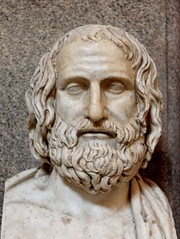
Euripides
480 BCE – 406 BCE
Euripides was the last of the three great tragedians of classical Athens (the other two being Aeschylus and Sophocles). Ancient scholars thought that Euripides had written ninety-five plays, although four of those were probably written by Critias. Eighteen or nineteen of Euripides' plays have survived complete. There has been debate about his authorship of Rhesus, largely on stylistic grounds and ignoring classical evidence that the play was his.[1] Fragments, some substantial, of most of the other plays also survive. More of his plays have survived than those of Aeschylus and Sophocles together, because of the unique nature of the Euripidean manuscript tradition. ([Source][1].) [1]:http://en.wikipedia.org/wiki/Euripides
Books
- The Trojan women of Euripides
- The Bacchae of Euripides
- The Orestes of Euripides
- La tragedie d'Evripide, nommee Hecvba
- Tragœdiæ quatiuor:Hecuba, Orestes, Phœnissæ
- Iphigeneia in Tauris
- Euripidis Hecuba
- Euripidou Trōades
- The Cyclops
- Medea
- Las troyanas de Eurípides
- Euripidou Hippolytus Stephanēphoros
- Euripides' Werke
- Iphigenie bei den Tauriern
- Tragedie
- Médée
- The Iphigeneia at Aulis
- Euripidou Bakchai
- Ausgewählte Tragödien des Euripides / erklärt von F. G. Schöne
- Euripides Feniciaensche; of, Gebroeders van Thebe
- Medea
- ALCESTIS
- נשי טרויה
- The Hippolytus
- [Euripide.] Le Fenicie
- Euripidis Orestes ad fidem manuscriptorum emendata et brevibus notis emendationum potissimum rationes reddentibus instructa
- [Hercules furens]
- Zes verloren tragedies van Euripides
- Iphigenia auf Tauris
- Tragoediae
- The Hippolytus of Euripides
- Alkestis; zum schulgebrauche
- Bacchae
- Iphigenia bei den Tauriern
- Ausgewählte tragödien
- Die Mänaden
- Evripidis tragoediae dvae Hecoba & Iphigenia in Aulide
- Iphigenia in Tauris
- Hecuba, & Iphigenia in Aulide Euripidis tragoediae
- The Hecuba and Medea of Euripides
- The Cretan woman


Author data: Open Library