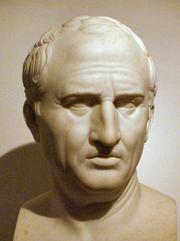
Cicero
106 BC – 43 BC
**Marcus Tullius Cicero** (pronounced /ˈsɪsɨroʊ/; Classical Latin: [ˈkikeroː]; January 3, 106 BC – December 7, 43 BC) was a Roman philosopher, statesman, lawyer, political theorist, and Roman constitutionalist. He came from a wealthy municipal family of the equestrian order, and is widely considered one of Rome's greatest orators and prose stylists. He introduced the Romans to the chief schools of Greek philosophy and created a Latin philosophical vocabulary (with neologisms such as humanitas, qualitas, quantitas, and essentia) distinguishing himself as a linguist, translator, and philosopher. An impressive orator and successful lawyer, Cicero thought that his political career was his most important achievement. Today, he is appreciated primarily for his humanism and philosophical and political writings. His voluminous correspondence, much of it addressed to his friend Atticus, has been especially influential, introducing the art of refined letter writing to European culture. Cornelius Nepos, the 1st-century BC biographer of Atticus, remarked that Cicero's letters contained such a wealth of detail "concerning the inclinations of leading men, the faults of the generals, and the revolutions in the government" that their reader had little need for a history of the period. Cicero's speeches and letters remain some of the most important primary sources that survive on the last days of the Roman Republic. During the chaotic latter half of the first century B.C. marked by civil wars and the dictatorship of Gaius Julius Caesar, Cicero championed a return to the traditional republican government. However, his career as a statesman was marked by inconsistencies and a tendency to shift his position in response to changes in the political climate. His indecision may be attributed to his sensitive and impressionable personality; he was prone to overreaction in the face of political and private change. "Would that he had been able to endure prosperity with greater self-control and adversity with more fortitude!" wrote C. Asinius Pollio, a contemporary Roman statesman and historian. Cicero became an enemy of Mark Antony, attacking him in a series of speeches. He was proscribed an enemy of the state by the Second Triumvirate and subsequently murdered in 43 BC. Source: Wikipedia
Books
- Select orations of Cicero
- De la divination de Cicéron
- M. Tullii Ciceronis Tusculanarum disuptationum, libri quinque
- Epistulae selectae
- Expliciunt Orationes Marci Tullii Ciceronis cu[m] Verrinis & Philippicis foeliciter
- M. Tullii Ciceronis De officiis libri tres
- [M.T. Ciceronis] epistolarum selectarum libri quatuor
- Cato Major, sive de senectute
- M.T. Ciceronis Orationes quaedam selectae
- Select orations of Cicero, chronologically arranged, covering the entire period of his public life
- Cicero's essays
- Ad Q. fratrem de oratore libri tres
- Sight and comprehension passages from Cicero
- M. Tvllii Ciceronis De legibus libri
- Orationes xiv selectae
- M. Tulli Ciceronis In M. Antonium orationes Philippicae prima et secunda
- M.T.C. Epistolae familiares accvrativs recognitae
- De senectute
- Tusculanarum disputationum, liber primus
- Rede für Cn. Plancius
- M. Tullii Ciceronis Brutus
- Cato Major, or A discourse on old age
- The life and letters of Marcus Tullius Cicero
- M. Tullii Ciceronis oratio pro L. Murena
- Praecepta rhetorica e libris Aristotelis, Ciceronis, Quintiliani, Demetrii et Longini
- Orazioni in difesa del re Dejotaro, della legge manilia, e di Publio Sulla
- Laelius sive De amicitia dialogus
- Orationes quaedam selectae, notis illustratae
- Select orations
- Orationes ex recensione J.G. Grævii cum Q. Asconio Pediano anonymo scholiaste et notis variorum
- Commentariolum de petitione consulatus, ad M.T. fratrem
- Elegant epistles: being a copious collection of familiar and amusing letters
- Ausgewählte Briefe Ciceros
- M.T. Ciceronis De legibus lib. III
- De re publica librorum reliquiae
- M.T. Ciceronis de officijs, libri tres, cum indice auctorũ, adagiorũq[ue] suo loco citatorũ ...
- Ad Quintum fratrem dialogi tres, De oratore
- Il fiore di rettorica posto nuovamente in luce da Bartolommeo Gamba nel 1821
- De finibus bonorum et malorum
- Discours pour Ligarius
- Divinatio in 2. Caecilium
- Cicero's Tusculan disputations, book first ; The dream of Scipio ; and, Extracts from the dialogues on old age and friendship
- On the Shortness of Life, Old Age, Friendship, and Divination
- Stoic Pack
- Stoic Collection

Author data: Open Library