
Karl Jaspers
23 February 1883 – 26 February 1969
"Karl Jaspers (1883–1969) began his academic career working as a psychiatrist and, after a period of transition, he converted to philosophy in the early 1920s. Throughout the middle decades of the twentieth century he exercised considerable influence on a number of areas of philosophical inquiry: especially on epistemology, the philosophy of religion, and political theory. His philosophy has its foundation in a subjective-experiential transformation of Kantian philosophy, which reconstructs Kantian transcendentalism as a doctrine of particular experience and spontaneous freedom, and emphasizes the constitutive importance of lived existence for authentic knowledge. Jaspers obtained his widest influence, not through his philosophy, but through his writings on governmental conditions in Germany, and after the collapse of National Socialist regime he emerged as a powerful spokesperson for moral-democratic education and reorientation in the Federal Republic of Germany. Despite his importance in the evolution of both philosophy and political theory in twentieth-century Germany, today Jaspers is a neglected thinker. He did not found a particular philosophical school, he did not attract a cohort of apostles, and, outside Germany at least, his works are not often the subject of high philosophical discussion. This is partly the result of the fact that the philosophers who now enjoy undisputed dominance in modern German philosophical history, especially Martin Heidegger, Georg Lukács and Theodor W. Adorno, wrote disparagingly about Jaspers, and they were often unwilling to take his work entirely seriously. To a perhaps still greater extent, however, his relative marginality is due to the fact that he is associated with the more prosaic periods of German political life, and his name is tarred with an aura of staid bourgeois common sense. Nonetheless, Jaspers' work set the parameters for a number of different philosophical debates, the consequences of which remain deeply influential in contemporary philosophy, and in recent years there have been signs that a more favourable reconstructive approach to his work is beginning to prevail." —Quoted from the [*Stanford Encyclopedia of Philosophy*][1]. [1]: http://plato.stanford.edu/entries/jaspers/
Books
- Das Gespräch mit der Philosophie
- Der wahre Arzt
- Vom Ursprung und Ziel der Geschichte
- The question of German guilt
- Leben als Grenzsituation
- La bombe atomique et l'avenir de l'homme
- Die Schuldfrage
- Die Hoffnungen unserer Zeit
- Die geistige Situation der Zeit
- ニイチェ根本思想
- Allgemeine Psychopathologie
- Wo stehen wir heute?
- Existenzerhellung, Grenzbewusstsein, Sinn der Geschichte
- Die massgebenden Menschen
- Die grossen Philosophen
- Kānt
- VOM EUROPÄISCHEN GEIST
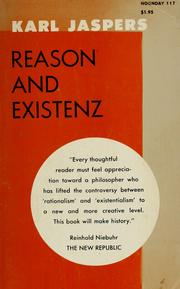
- Reason and Existenz
- Allgemeine Psychopathologie
- Way to wisdom
- Sheʼelat ha-ashmah
- Myth and Christianity
- Felsefi inanç
- Drei Gründer des Philosophierens; Plato, Augustin, Kant
- Die Atombombe und die Zukunft des Menschen
- Etica e destino
- Philosophy and science
- L'esistenzialismo
- Smysl i naznachenie istorii
- Six Existentialist Thinkers
- Das Lachen
- ʿĀlam dar āyina-i tafakkur-i falsafī
- General psychopathology
- 哲学入門
- Max Weber
- Jaspers et la scission de l'être
- 現代の哲学的考察
- Max Weber, Politiker, Forscher, Philosoph
- Chân lý va biếu tưƠng
- Strindberg und Van Gogh
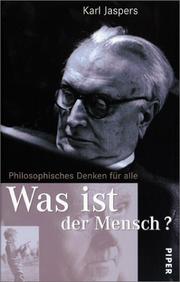
- Was ist der Mensch?
Author data: Open Library