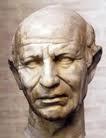
Sallust
86 B.C. – 34 B.C.
Gaius Sallustius Crispus, generally known simply as Sallust, (86-34 BC), a Roman historian, belonged to a well-known plebeian family, and was born at Amiternum in the country of the Sabines. Throughout his career Sallust always stood by his principle as a popularis, an opposer of Pompey's party and the old aristocracy of Rome. After an ill-spent youth, Sallust entered public life and won election as Quaestor in 55 and one of the tribunes of the people in 52, the year in which the followers of Milo killed Clodius in a street brawl. Sallust then supported the following prosecution of Milo. He also had hostilities with the famous orator Cicero. From the beginning of his public career, Sallust operated as a decided partisan of Caesar, to whom he owed such political advancement as he attained. In 50 the censor Appius Claudius Pulcher removed him from the Senate on the grounds of gross immorality (probably really because of his friendship with Caesar). In the following year, no doubt through Caesar's influence, he was reinstated. In 46 he served as a praetor and accompanied Caesar in his African campaign, which ended in the decisive defeat of the remains of the Pompeian war party at Thapsus. As a reward for his services, Sallust gained appointment as governor of the province of Africa Nova. In this capacity he committed such oppression and extortion that only the influence of Caesar enabled him to escape condemnation. On his return to Rome he purchased and began laying out in great splendour the famous gardens on the Quirinal known as the Horti Sallustiani or Gardens of Sallust. These gardens would later belong to the emperors. Sallust then retired from public life and devoted himself to historical literature, and further developing his Gardens of Sallust, upon which he spent much of his accumulated wealth (<a href=https://en.wikipedia.org/wiki/Sallust>Wikipedia</a>).
Books
- Hoc in uolumine haec continentur
- Opera Sallustiana
- C. Crispi Sallustii, De coniuratione Catilinæ, & bello Iugurthino, historiæ
- Hoc in volumine haec continentur
- Opera Salustiana
- Catiline and Jugurthine War
- Belli Catilinarii et Jugurthini historiae
- C. Sallusti Crispi De bello Catilinario et Jugurthino
- Die Verschwörung des Catilina
- History of the war against Jugurtha, and of the conspiracy of Catiline
- The Catilina and Jugurtha of Sallust
- C. Sallvstii. Crispi Conivratio. Catilinae et. Bellvm
- La congiura di Catilina, e La guerra di Giugurta
- Des Kaius Krispus Sallustius Jugurtha
- Sallust's History of the war against Jugurtha, and of the Conspiracy of Catiline
- Catilinaria et Jugurthina bella
- C. Crispi Sallustii Catilinaria et Jugurthina bella
- Válka s Jugurthou
- De bello Iugurthino liber
- C. Sallustii Crispi quae extant
- C. Crispi Sallustii De coniuratione Catilinae
- C.C. Sallustio
- Catilina et Jugurtha
- Opere di Vittorio Alfieri ristampate nel primo centenorio della sua morte ...
- Sallust's Catiline-war
- C. Sallustii Crispi Bellum Catilinarium, et Jugurthinum
- The Catilinarian conspiracy from Sallust & Cicero
- Opera omnia cum commentariis integris Joh. Rivii, Aldi Manutii Petri Ciacconii, Fulvii Ursini, & Heliae Putschii, et selectis Jani Gruteri, H. Glareani, & aliorum
- Opera
- Opere postume di Vittorio Alfieri
- C. Crispi Sallustii Opera quae exstant
- Catilinae coniuratio
- Sallust's History of the war against Jugurtha, and of the conspiracy of Cataline
- La conjuration de Catilina
- C. Sallusti Crispi Opera quae supersunt
- De Catilinae coniuratione
- Obras de Cayo Crispo Salvstio
- Catilina Iugurtha historiarum reliquiae
- C. Sallvstivs Crispvs
- The history of the conspiracy of Catiline and the Jugurthine war
- C. Crispi Sallvstii De conivratione Catilinae
- De Catilinae coniuratione et De bello Iugurthino
- Präparation zu Sallust's Werken
- Salluste
Author data: Open Library