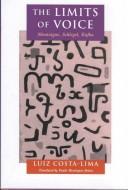
The limits of voice
Montaigne, Schlegel, Kafka
The title of this work derives from Costa-Lima's reading of what is probably the most famous passage in Kant's Third Critique. In Kant's thesis that the results of aesthetic judgment are "generally communicable but without the mediation of a concept," Costa-Lima discovers the necessity to identify and underscore a silence. This silence - these "limits of voice" - becomes the complex metonymy for the central theme of this book, literary experience as a case of aesthetic experience. In pursuing this theme, Costa-Lima views aesthetic and literary experience as a historically limited potentiality and examines the limits of aesthetic experience, which comes from its dependence on contextual requirements. The concern about "limits of voice" is developed on three different levels. First, Costa-Lima focuses, as a historical and systematic condition for aesthetic and literary experience, on subjectivity as the subject's right to speak in his/her own name. Second, he argues that, although historical modes of speaking and experiencing were inscribed into and legitimized by cosmological constructions, subjectivity requires the existence of a context no longer grounded in cosmology, which he re
For young readers
Book data: Open Library