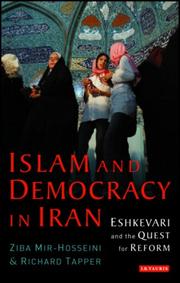
Islam and democracy in Iran
by Hasan Yousefi Eshkevari, Ziba Mir-Hosseini, Richard Tapper
"In today's world all eyes are on Iran, which has grappled with an experiment that has had a massive global impact. For some, the Iranian Revolution of 1978-79 was the triumph of a modern, political Islam, heralding Muslim justice and economic prosperity. Others, including many of the original revolutionaries, saw religious fanatics attempting to roll back time by creating a despotic theocracy. Either way, the Iranian Revolution changed the Muslim world. It not only inspired the Muslim masses but also reinvigorated intellectual debates on the nature and possibilities of an Islamic state. The new 'Islamic Republic of Iran' combined not just religion and the state, but theocracy and democracy. Yet the revolution's heirs were soon engaged in a protracted struggle over its legacy. Dissident thinkers, from within an Islamic framework, sought a rights-based political order that could accept dissent, tolerance, pluralism, women's rights and civil liberties. Their ideas led directly to the presidency of Mohammad Khatami and, despite their political failure, they did leave a permanent legacy by demystifying Iranian religious politics, and condemning the use of the Shariah to justify autocra
For young readers
Book data: Open Library