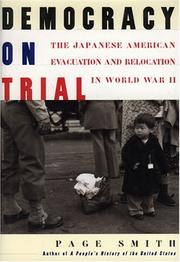
Democracy on trial
by Page Smith
In 1942, following Pearl Harbor, President Franklin D. Roosevelt issued Executive Order 9066, which authorized the U.S. Army to "exclude" "all persons" considered a threat to national security. In the final analysis these turned out to be some 110,000 Japanese Americans. Losing their jobs, their businesses, their personal property, and their homes, these "persons of Japanese ancestry" - 72,000 of whom were U.S. citizens by birth - were first taken to temporary "assembly centers" (including stalls in converted racetrack stables) and then shipped to "relocation centers" in California, Arizona, Utah, Idaho, Wyoming, and Arkansas, where many of them spent the next three years of their lives. In Democracy on Trial, Page Smith tells the dramatic story of the men, women, and children who endured this tragic chapter in American history. Democracy on Trial also exposes the remarkable - and unexpected - range of military, political, economic, racial, and personal motives of public figures such as General John DeWitt, who was in charge of the evacuation; U.S. Attorney General Francis Biddle, who vigorously opposed the internment; Walter Lippmann, the influential liberal columnist, who warned
For young readers
Book data: Open Library