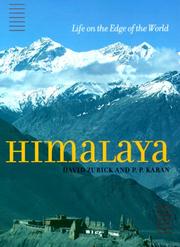
Himalaya
The majestic natural beauty of the Himalaya Mountains has inspired awe and religious devotion in people around the world for millennia. With thirty peaks rising over 25,000 feet (7,620 meters) -- including Everest and Kanchenzonga, the world's highest and third-highest peaks -- the Himalaya dwarf all other mountain ranges. Sprawling 2,700 kilometers across India, Pakistan, Nepal, Tibet, and Bhutan, the Himalaya possess an abundance of ecological niches, from subtropical to arctic climates, and support vast quantities of flora and fauna -- more than 650 varieties of orchids thrive in the wet mountain region of Sikkim alone. In the valleys, a surprising number of tenacious peoples have over centuries carved out diverse cultures in the harsh mountain environment. Although seemingly timeless, the Himalaya are anything but unchanging. The mountains themselves continue to grow an average of one centimeter per year, with some peaks rising ten centimeters in a single year. More alarming are the profound environmental and cultural changes occurring throughout the region. In Himalaya: Life on the Edge of the World, David Zurick and P. P. Karan explore these dynamic changes through geological
For young readers
Book data: Open Library