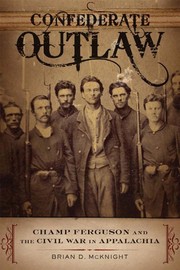
Confederate Outlaw
In the fall of 1865, the United States Army executed Confederate guerrilla Champ Ferguson for his role in murdering fifty-three loyal citizens of Kentucky and Tennessee during the Civil War. Long remembered as the most unforgiving and inglorious warrior of the Confederacy, Ferguson has often been dismissed by historians as a cold-blooded killer. In Confederate Outlaw: Champ Ferguson and the Civil War in Appalachia, biographer Brian D. McKnight demonstrates how such a simple judgment ignores the complexity of this legendary character. In his analysis, McKnight maintains that Ferguson fought the war on personal terms and with an Old Testament mentality regarding the righteousness of his cause. He believed that friends were friends and enemies were enemies -- no middle ground existed. As a result, he killed prewar comrades as well as longtime adversaries without regret, all the while knowing that he might one day face his own brother, who served as a Union scout. Ferguson's continued popularity demonstrates that his bloody legend did not die on the gallows. Widespread rumors endured of his last-minute escape from justice, and over time, the borderland terrorist emerged as a folk hero
For young readers
Book data: Open Library