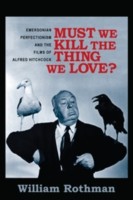
Must We Kill The Thing We Love Emersonian Perfectionism And The Films Of Alfred Hitchcock
William Rothman argues that the driving force of Hitchcock's work was his struggle to reconcile the dark vision of his favorite Oscar Wilde quote, "Each man kills the thing he loves," with the quintessentially American philosophy, articulated in Emerson's writings, that gave classical Hollywood movies of the New Deal era their extraordinary combination of popularity and artistic seriousness. A Hitchcock thriller could be a comedy of remarriage or a melodrama of an unknown woman, both Emersonian genres, except for the murderous villain and godlike author, Hitchcock, who pulls the villain's strings--and ours. Because Hitchcock believed that the camera has a murderous aspect, the question "What if anything justifies killing?," which every Hitchcock film engages, was for him a disturbing question about his own art. Tracing the trajectory of Hitchcock's career, Rothman discerns a progression in the films' meditations on murder and artistic creation. This progression culminates in Marnie (1964), Hitchcock's most controversial film, in which Hitchcock overcame his ambivalence and fully embraced the Emersonian worldview he had always also resisted. Reading key Emerson passages with the deg
For young readers
Book data: Open Library