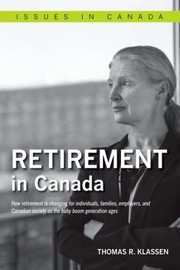
A century ago, the average Canadian lifespan was 60; today, we can expect to live 20 years longer than that. And recent generations have witnessed other major social shifts in Canada, from women entering the workforce to alterations in traditional career patterns, from evolutions in the once-inviolable nuclear family to the decline of employer pension schemes. As the arc of our lives continues to change, so too will the experience of our retirement. An important factor in the changingreality of retirement is the influence of the baby boom generation, the demographic group born in the wake of World War II, which comprises some 30 percent of the Canadian population. As this generation has transformed society, challenging gender and ethnic stereotypes and redefining popular culture, so will it transform the choices and challenges associated with retirement. But as Thomas R.^ Klassen - a professor of political science and public policy and also a well-known media commentator -notes, this generation is not a homogeneous block, and there are few constants in the preferences of those near retirement, as well as those already retired. Unlike the past, the future of retirement holds a wide
For young readers
Book data: Open Library