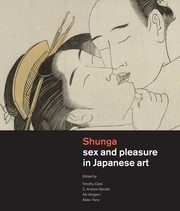
Shunga
Sex and Pleasure in Japanese Art
In early modern Japan, 1600–1900, thousands of sexually explicit paintings, prints, and illustrated books with texts were produced, known as ‘spring pictures’ (shunga). Frequently tender, funny and beautiful, shunga were mostly produced within the popular school known as ‘pictures of the floating world’ (ukiyo-e), by celebrated artists such as Utamaro and Hokusai. Early modern Japan was certainly not a sex-paradise; however, the values promoted in shunga are generally positive towards sexual pleasure for all. Official life in this period was governed by strict Confucian laws, but private life was less controlled in practice. Shunga is in some ways a unique phenomenon in pre-modern world culture, in terms of the quantity, the quality and the nature of the art that was produced. This catalogue of a major exhibition at the British Museum marks the culmination of a substantial international research project and aims to answer some key questions about what shunga was and why it was produced. In particular the social and cultural contexts for sex art in Japan are explored. Erotic Japanese art was heavily suppressed in Japan from the 1870s onwards as part of a process of cultural ‘moderni
For young readers
Book data: Open Library