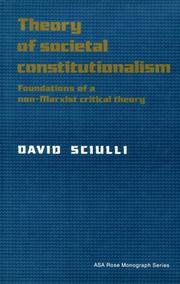
Theory of societal constitutionalism
"The problem of social authoritarianism is commonplace in practice, and yet it exceeds the scope of application of existing social and political theories. When private organizations and institutions wield their collective power arbitrarily within a modern civil society, a nation-state's government and economy may remain (or become) liberal-democratic and pluralistic. Actors, however, experience increasing social control in their everyday lives." "Only by distinguishing analytically between whether social order within any organization, institution, or sector of a modern civil society is based on actors' demonstrable social control or on their possible social integration can a nation-state's susceptibility to social authoritarianism be isolated empirically. Bringing this distinction to the literature and to research, the theory of societal constitutionalism leads to a critical reappraisal of the findings of comparative politics and also the findings of the sociologies of law, professions, and organizations and occupations." "Research findings in these fields that have hitherto appeared unrelated are now revealed both to explain historical shifts in a nation-state's direction of socia
For young readers
Book data: Open Library