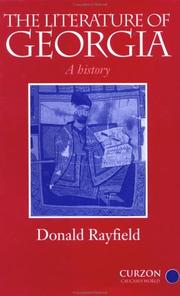
The Literature of Georgia
A History
Early thirteenth-century Georgian had as many speakers and readers as English in Shakespeare's day, and medieval Georgian literature is important in terms of world cultural history, representing a bridge between classical and oriental worlds. Donald Rayfield analyses the literature in the context of Greek, Persian, and Russian influences, and presents its hitherto overlooked, rich and unique artistry. In 1225 the Mongols broke up the Georgian state and crippled its culture: Rayfield describes the dormancy of literature until an eighteenth-century Renaissance, and the subsequent flourishing artistry of the nineteenth and early twentieth centuries when, under the auspices of symbolism and futurism, Georgian poetry and prose achieved real originality. The world-class poetry of Vazha Pshavela, Galaktion Tabidze, and Paolo Iashvili is discussed here, as are the Soviet period novelists Konstantine Gamsakhurdia, Grigol Robakidze, and Mikheil Javakhishvili, writer of the much acclaimed Kvachi Kvachantiradze. The History ends with a study of living writers, the novelists Otar Chiladze and Chabua Amirejibi, and poets such as Ana Kalandadze and Lia Sturua. A major contribution to an area of g
For young readers
Book data: Open Library