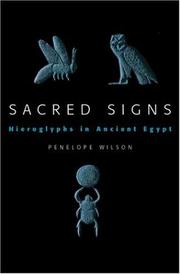
Sacred signs
The hieroglyphs of ancient Egypt have fascinated people for over three thousand years. In this engaging new study, Penelope Wilson offers a wide ranging look at this ancient form of writing, touching on everything from basic principles of translation to its broader function in Egyptian culture. Sacred Signs illuminates the cultural significance of hieroglyphs, showing how it was used in monumental art and as the rarified language of the gods. Wilson points out that the Egyptian word for pictorial writing was "medu-netjer," which means "words of god." Hieroglyphs were an exalted mode of communication, used to speak with the gods or to guide rulers in the afterlife (for instance, hieroglyphs might describe a set of spells, rituals, and the route to the afterlife for use by the king or queen). Indeed, hieroglyphs differed from everyday writing and the average Egyptian was unable to read them-only the elite were taught the pictorial signs. Throughout the book, Wilson illuminates the writing system itself. We learn that hieroglyphs can be read either left-to-right or right-to-left and that animals, birds, people, serpents, and fish were drawn in profile, all facing the same way, so that
For young readers
Book data: Open Library