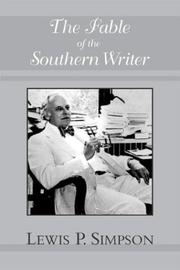
The fable of the southern writer
In books such as The Dispossessed Garden and The Brazen Face of History, Lewis P. Simpson has outlined - and in large part defined - the southern literary imagination. The Fable of the Southern Writer expands upon his previous work as it contemplates the drama of the literary self in quest of its historical identity. Written over the past decade, the eleven essays in this collection have as their centering theme a search for the autobiographical motive in southern fiction and criticism. Simpson directs his focus in these essays, which are more meditative than argumentative, from a variety of angles, to suggest that the impulse and vision of the southern writer derive from the same tension that has gripped modern writers in general: the effort to grasp and interpret the relationship between the self and history. Simpson ponders the role of the self as literary artist attempting to confront and order a desacralized world, a world in which everything and everybody, every aspect of nature and human consciousness, has with the advent of science taken on purely historical dimensions. Considering a broad spectrum of writers - including Thomas Jefferson, John Randolph, Mark Twain, Robert P
For young readers
Book data: Open Library