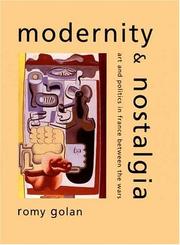
Modernity and nostalgia
art and politics in France between the wars
by Romy Golan
Late nineteenth- and early twentieth-century France is generally thought of as the embodiment of artistic modernism. However, in this original and perceptive study, Romy Golan argues that, after the First World War, traumatized by the experience of the trenches and then by the stranglehold of the Depression, France suffered a crisis of confidence so profound that it initiated a period of cultural, political, and economic retrenchment that lasted into the Vichy years. Golan argues that reactionary issues such as anti-urbanism, the return to the soil, regionalism, corporatism, xenophobia, and doubts about the new technology became central to cultural and art-historical discourse. Focusing on the overlap of avant-garde and middle-of-the-road production, she investigates the import of these issues not only in, painting, sculpture, and architecture (concentrating on the work of Leger, Picasso, Le Corbusier, Ozenfant, Derain, the Surrealists, and the so-called naifs), but also in the decorative arts, in the spectacle of world and colonial fairs, and in literature. Throughout she finds evidence that artists turned from the aesthetics of the machine age toward a more organic, naturalistic
For young readers
Book data: Open Library