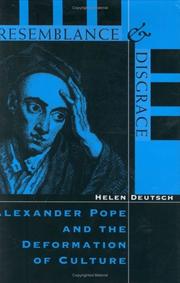
Resemblance & disgrace
Between the figure of Alexander Pope, a hunchback standing 4 feet 6 inches tall, and the perfect polished form of his poetry is an undeniable contradiction. Undeniable but not necessarily unfortunate, this contradiction of deformity and form may have been Pope's ultimate couplet, Helen Deutsch suggests, the paradox from which his contemporary cultural authority sprang. By restoring the poet's image to view against the cultural background that branded it as monstrous, Deutsch recasts Pope's literary career, from his translations of Homer to his imitations of Horace, as itself a form of monstrous embodiment - a stamping of his own personal, disfigured image on fragments of the cultural past. In Resemblance and Disgrace deformity appears as a poetics jointly constructed by the author and his audience, and Pope as an instrumental figure in the history of authorship whose personal vision and unique visibility have influenced succeeding images of cultural authority. Like the miniatures of which Pope was so fond, the book is at once particular in its focus and wide-ranging in its conceptual scope. While drawing on recent feminist, historicist, and materialist criticism of Pope, as well as
For young readers
Book data: Open Library