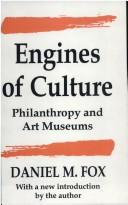
In the United States, art has become a major industry, like health care, education, and defense. In the 1950s, however, arts policy was an area of public policy, in which the United States seemed to lag behind other countries. One of Daniel M. Fox's aims in writing Engines of Culture thirty years ago was to show why American social policy was incomplete with respect to the arts. While it was easy to garner support for government funding of hospital intensive care units or colleges of engineering, it was difficult to justify public subsidies for painting, sculpture, ballet, and music. Fox's own doubts informed the research that led to Engines of Culture. . In the 1950s and 1960s, philanthropy became a focus of scholarship. Foundations, interested in the subject, made grants to study it; but also, many social scientists became increasingly dubious about the ability of the state to sustain certain sources of creativity and social reform. Engines of Culture argues that art museums are an instructive example of the accommodation of public and private interests. In his new introduction, Fox places Engines of Culture in its personal and intellectual contexts, assesses the book's strengths
For young readers
Book data: Open Library