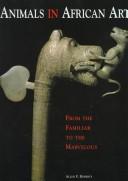
Animal images are so common in African art, and their meanings and purposes assumed to be so obvious, that they are taken for granted. Indeed, Animals in African Art is the first major book wholly dedicated to the subject. Once the animals in African art are looked at more closely, important questions arise. Why is it that from the astounding diversity of life-forms in Africa, so very few animals are chosen as subjects of visual and performative arts? Why are the animals that do appear repeatedly in African art so often so downright peculiar - even preposterous? And why do zoomorphic masks, figures, and other objects almost always refer to human being and purpose? In other words, why and how are animals such a useful, if purposefully distorting mirror of humanity? What does it mean to "become" a hyena or an eland by donning a mask or entering a trance? Indeed, what does it mean to be "human" or "animal," in the first place? Answers to such questions are by no means as readily forthcoming as one might assume. To understand why and how some animals are so "good to think" (as well as good to eat) requires wending one's way along the sinuous paths of African logics. Emphasis is placed
For young readers
Book data: Open Library