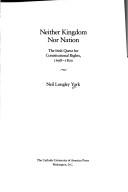
Neither kingdom nor nation
The rise and fall of the Anglo-Irish Protestant Ascendancy continues to fascinate historians. During the eighteenth century, the Anglo-Irish attempted to identify a constitutional tradition that justified their domination in Ireland and explained their conception of equal partnership in the British empire. Although they claimed that they led a "free" people living in an "independent" kingdom, that "free" people included a disfranchised and exploited Catholic majority, and their "independent" kingdom was actually a subordinate part of the British empire. The reified constitution that the Anglo-Irish looked to as the foundation of their political rights was not really their creation. They borrowed from an earlier generation of Irish constitutionalists, many of whom were, ironically, Catholics. Thus Patrick Darcy's 1643 Argument deserves as prominent a place in the emergence of Irish constitutionalism as William Molyneux's more famous 1698 Case of Ireland Stated. And despite what the Anglo-Irish elite called "parliamentary independence" in 1782, they did not escape their dependence on - or subordination to - Great Britain. Moreover, their persistent exclusivity, their unwillingness to
For young readers
Book data: Open Library