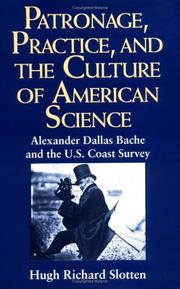
Patronage, practice, and the culture of American science
In this book Hugh Richard Slotten explores the institutional and cultural history of science in the United States. The main focus is on the activities of Alexander Dallas Bache - great-grandson of Benjamin Franklin and the acknowledged "chief" of the American scientific community during the second third of the nineteenth century. Bache played a central role in the organization and management of a number of key scientific institutions, including the American Association for the Advancement of Science, the Smithsonian Institution, and the National Academy of Sciences. But his dominance in these institutions was made possible through his control of an organization less well known today, the United States Coast Survey, which he superintended from 1843 until his death in 1867. Under Bache's command the Coast Survey became the central scientific institution in antebellum America. Using richly detailed archival records, Slotten pursues an analysis of Bache and the Coast Survey that illuminates important historiographic themes. We gain a better understanding of the particular style of nineteenth-century American science by examining the role of the Coast Survey as a source of patronage. Pe
For young readers
Book data: Open Library