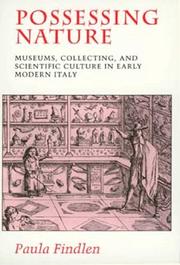
Possessing nature
In 1500 few Europeans considered nature an object worthy of study, yet within fifty years the first museums of natural history had appeared, chiefly in Italy. Vast collections of natural curiosities - including living human dwarves, "toad-stones," and unicorn horns - were gathered by Italian patricians as a means of knowing their world. The museums built around these collections became the center of a scientific culture that over the next century and a half served as a microcosm of Italian society and as the crossroads where the old and new sciences met. In Possessing Nature, Paula Findlen vividly recreates the lost world of late Renaissance and Baroque Italian museums and demonstrates its significance in the history of science and culture. Based on exhaustive research into natural histories, letters, travel journals, memoirs, and pleas for patronage, Findlen describes collections and collectors great and small, beginning with Ulisse Aldrovandi, professor of natural history at the University of Bologna. Aldrovandi, whose museum was known as the "eighth wonder" of the world, was a great popularizer of collecting among the upper classes. From the universities, Findlen traces the spre
For young readers
Book data: Open Library