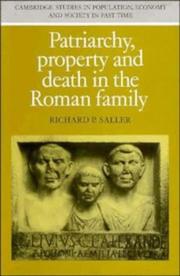
Patriarchy, property, and death in the Roman family
The Roman father, with his monopoly of property rights and power of life and death over his children, has been prominent in the formulation of the concept of patriarchy in European thought. However, the severe, authoritarian image, based on legal rules and legends, provides, according to Professor Saller, a misleading view of relations between the generations in Roman families. Starting from a demographic analysis, aided by computer simulation of the kinship universe, he shows how the family changed through a Roman's life course, leaving many children fatherless. Examination of the Roman language, exempla, and symbolic behaviour of family relations reveals the mutuality of family obligation within the larger household in which children and slaves were differentiated by status marked by the whip. The concerned, loving father appears as a contrast to the exploitative master. An understanding of demography and cultural values, in turn, yields insights into the use of the sophisticated Roman legal institutions of inheritance, guardianship, and dowry for the transmission of patrimony essential to the continuity of family status. This book contains much of importance to scholars and stud
For young readers
Book data: Open Library