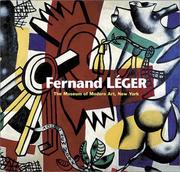
Fernand Leger
by Carolyn Lanchner, Matthew Affron, Jodi Hauptman, Glenn Lowry, Fernand Léger, Fernand Léger
Fernand Leger is the only major modern artist to choose modernity itself as his subject. From his early series "Contrastes de formes," of 1913-14 - the first fully abstract works to emerge from Cubism - through his paintings of construction workers from the late 1940s and early 1950s, his enduring subject was the pulse and dynamism of everyday life. Leger saw the twentieth-century environment as "a state of contrasts," a condition that he translated into art through forceful juxtapositions of shape, color, and line. His attempt to reconcile the formal concerns of artmaking with issues of social responsibility continues to be relevant to the art world of today. This book is published to accompany a retrospective exhibition appearing at The Museum of Modern Art in the winter and spring of 1998 - New York's first in-depth survey of Leger's work in over forty years. The essays include Carolyn Lanchner's account of Leger's experience of and interest in America (he visited the United States several times, and lived there during World War II), and also of America's interest in him. Jodi Hauptman explores refractions of Leger's interests in the work of more recent artists, and Matthew Affr
For young readers
Book data: Open Library