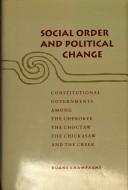
Social order and political change
Under what conditions can democratic governments be formed and become stable? The author addresses this question in a unique way that brings sociological and political theory to bear on the study of traditional societies, long the preserve of historians and anthropologists. By examining in detail the history of four American Indian societies--the Cherokee, the Choctaw, the Chickasaw, and the Creek--the author documents a general theory of politics and constitutional government. The four societies present an opportunity to study the process of democratic institution building in a controlled, comparative historical context. The societies were subject to similar geopolitical relations with the United States; they were incorporated into the same sequence of world economic system relations (initially fur trade and then the cotton market); they experienced the emergence of class structures; and they all produced some form of constitutional democracy.^ The Cherokee, however, adopted a stable constitutional government earlier and with less coercion than the other three nations. Why was this so? With the aid of comparative analysis, the author finds the answer in the Cherokee differentiatio
For young readers
Book data: Open Library