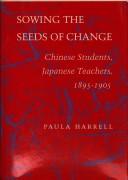
Sowing the seeds of change
"In the critical decade between the Sino-Japanese and Russo-Japanese wars, perhaps as many as 10,000 Chinese students converged on Tokyo in what was the first large study-abroad movement anywhere in the world.". "Following China's defeat by Japan in 1895, sending young Chinese to Japan for schooling seemed wise policy to leaders in both countries. To reform-minded pragmatists at the helm of Ch'ing government, study in Japan meant access to modern ideas and technology that would strengthen the state and their own power. To Japan's leaders, training thousands of young Chinese fit their objective of creating a strong China under Japanese tutelage; together, the two countries could form an Asian bulwark against the encroachments of the West. But this blueprint for study abroad failed to consider what the students' own goals might be for a modernizing China.". "For the Chinese students, exposure to an economically stronger, intellectually more open Japan inspired visions of a new China, free of Ch'ing mismanagement, more broadly representative politically, and capable of holding back imperialism in any form, Western or Japanese. Increasingly alienated from the Ch'ing state, Japan-educat
For young readers
Book data: Open Library