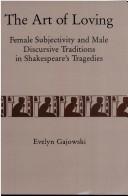
The art of loving
To be a subject is to be able to speak, to give meaning. The Art of Loving interrogates the phenomenon of "theatrical subjectivity"--Female protagonists as both subjects and objects on the early modern English stage and within the illusion of Shakespeare's tragedies. The disparity between females as acting, speaking subjects onstage and male protagonists' objectifications of them constitutes the dominating gendered irony of the dramatic texts. In Romeo and Juliet, Othello, and Antony and Cleopatra, Professor Gajowski argues, women are not portrayed as they are valued by men. Endowed with a self-estimation that is independent of masculine estimations of them, Juliet, Desdemona, and Cleopatra subvert Petrarchan, Ovidian, and Orientalist discursive traditions by which males construct females as gendered, colonized others. The independence of their self-evaluation from conflicting male desire and repugnance for them accounts for their "infinite variety." The uniqueness of Shakespeare's representation of heterosexual relations is his creation of female protagonists who are relational, yet independent, human beings. The empowered female protagonists of Shakespeare's comedies are rightly
For young readers
Book data: Open Library