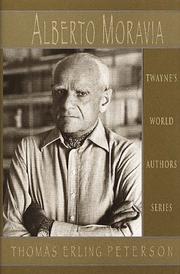
Widely acknowledged as a major voice in contemporary Italian literature, Alberto Moravia (1907-1990) published more than 30 books in his lifetime. A novelist, short story writer, and essayist, Moravia is renowned for his exquisite portrayals of the decadence, shallow values, and obsessions of the sex and money driven Italian middle class. His first novel, The Time of Indifference (1929), was an immediate sensation; its descendants, among them The Conformist, The Empty Canvas, and The Lie, positioned him firmly as a master of the narrative art, a moralist, and a realist applauded for his humanism and his powers of observation, deduction, and analysis. Moravia also explored characters from the Italian working class in The Woman of Rome, Two Women, and Roman Tales. Censored in the 1930s and 1940s by both Mussolini's fascists and the Vatican, Moravia is credited with developing an Italian literature of existentialism and with placing Italian literature in a European context. With Alberto Moravia, the teacher and scholar Thomas Erling Peterson contributes the first study of the writer to be published since Moravia's death in 1990. Arguing that Moravia was an intellectual and a craftsman
For young readers
Book data: Open Library