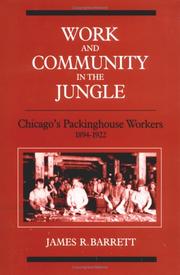
Work and Community in the Jungle
Chicago's packinghouse workers were not the hopeless creatures depicted by Upton Sinclair in "The Jungle", but active agents in the early twentieth century transformation that swept urban industrial America. In his case study of Chicago's Union Stockyards, Barrett focuses on the workers - older skilled immigrants, new immigrant common laborers, migrant blacks, and young women workers - and the surrounding neighborhoods. The lives and communities of these workers accurately convey the experience of mass-production work, the quality of working-class life, the process of class formation and fragmentation, and the changing character of class relations. Because Packingtown's struggle for existence was linked directly to the character of work and employment in the industry, unionization played an important role in the lives of these workers. Although unionization was associated with both improving the quality of life and creating a viable community, workers were divided by race, ethnic identity, and skill. "Work and Community in the Jungle" discusses a wide range of social, economic, and cultural factors that resulted in class cohesion and fragmentation. Addressing the broader problem of
For young readers
Book data: Open Library