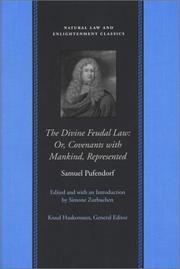
The Divine Feudal Law
"Samuel von Pufendorf (1632-94), German historian and theorist of natural law, was renowned in Europe as one of the founding fathers of the modern theory of natural law. Influenced by the writings of both Grotius and Hobbes, Pufendorf's works on natural law were textbooks for all of Europe for over a century and were far more widely read than any other treatments of the subject." "The Divine Feudal Law (1695) can be seen as a complement to his 1687 treatise on toleration, Of the Nature and Qualification of Religion in Reference to Civil Society (2002, Liberty Fund), which was written in reaction to Louis XIV's revocation of the Edict on Nantes in 1685 and which clarifies that toleration should be applied only when the unification of denominations proves impossible. In The Divine Feudal Law Pufendorf attempts to demonstrate that a union of Lutherans and Calvinists is possible. The aim is not to eliminate disagreements in religion but to take away the evils that arise from those disagreements, and Pufendorf advises that the proper means of securing the peaceful coexistence of different confessions should occur via a mutual agreement rather than enforcement by law. It is important to
For young readers
Book data: Open Library