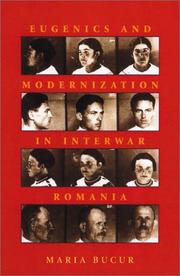
Eugenics and Modernization in Interwar Romania (Pitt Russian East European)
by Maria Bucur
"Since Its Rise as a scientific discipline in the late nineteenth century, eugenics has both fascinated and repelled generations of biologists, doctors, social reformers, politicians, and historians. Much has been reported and debated on this controversial subject, from Hitler's Germany to The Bell Curve, yet studies have generally neglected Eastern Europeans' interest in eugenics. Between 1918 and 1948, a growing group of professionals - prominent physicians, academicians, scientists, and sociologists - set out to transform Romanian health care, society, and the state according to the gospel of eugenics.". "Maria Bucur sheds new light on eugenics in Eastern Europe by focusing on Romania during the period between World Wars I and II. She demonstrates how Romanian eugenicists helped change the concepts of social organization and reform, of public health and education, of the role of science in generating social reform, of women's roles, and of the state's responsibility for social welfare. Bucur also illustrates their role in generating important public health legislation, from the broad-based Moldovan Law of 1930 and the legalization of abortion in cases based on eugenic criteria,
For young readers
Book data: Open Library