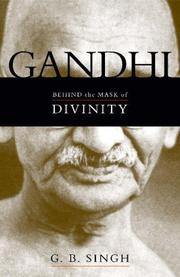
"Mohandas K. Gandhi (1869-1948) is regarded as one of the greatest leaders of the twentieth century. In addition to being hailed as the leader of India's movement toward independence from British colonial rule using the methods of nonviolent resistance (Satyagraha), his popularity crosses all the boundaries of political, religious, ethical, moral, spiritual, social, and national systems. In fact, he is seen as so central to human rights that various societies, both Eastern and Western, have come to view him as an icon of nonviolence, rather than as a fallible human. Societies require icons of virtuous behavior to provide an ideal toward which to strive; Jesus Christ and Martin Luther King Jr. are similar examples (the latter deriving his own philosophy from that of the Gandhi icon). However, from a historical perspective, it is important to look beyond these icons to gain an objective viewpoint of a person's life. Only in this informed manner can we reach our own conclusions about the meaning of a person's contributions to society. Unfortunately, the body of literature about Gandhi is of such immense proportion that to wade through it to find the real Gandhi - the man in his own wo
For young readers
Book data: Open Library